Every successful UPSC or UPPCS aspirant has one habit in common—they regularly test their preparation. Reading books and making notes are important, but unless you assess yourself through quality mock tests, it is difficult to identify strengths, weaknesses, and the areas that require improvement.
A well-designed Free Test Series for UPSC and UPPCS allows aspirants to experience the actual examination environment, improve conceptual understanding, and develop confidence through continuous practice.
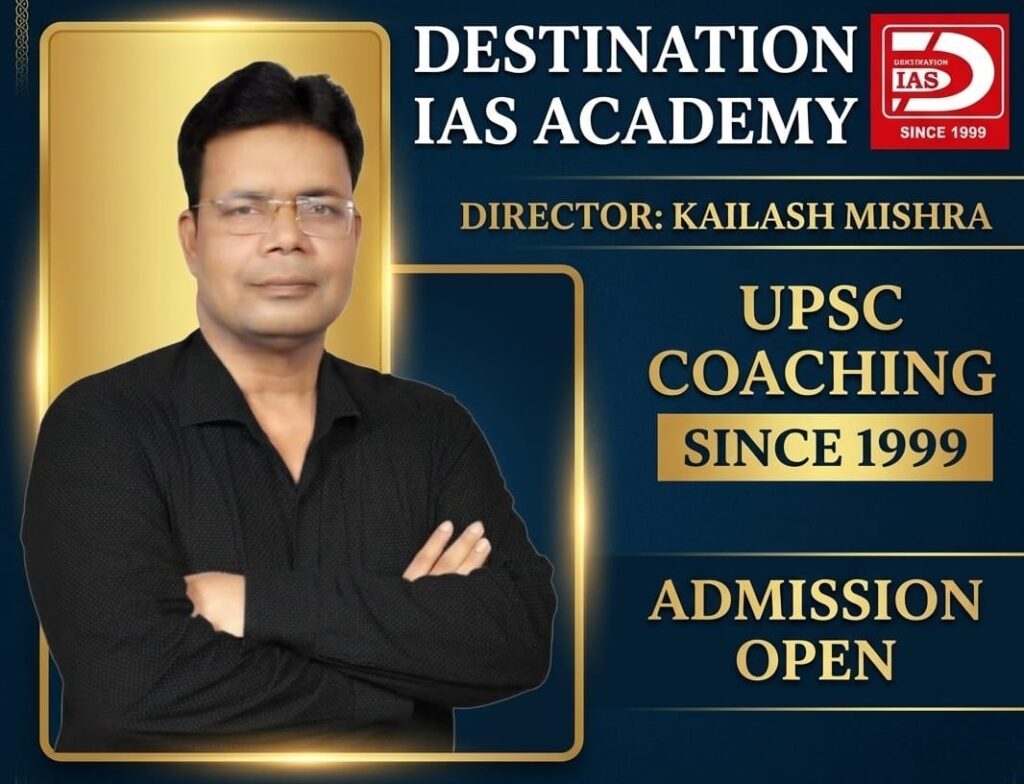
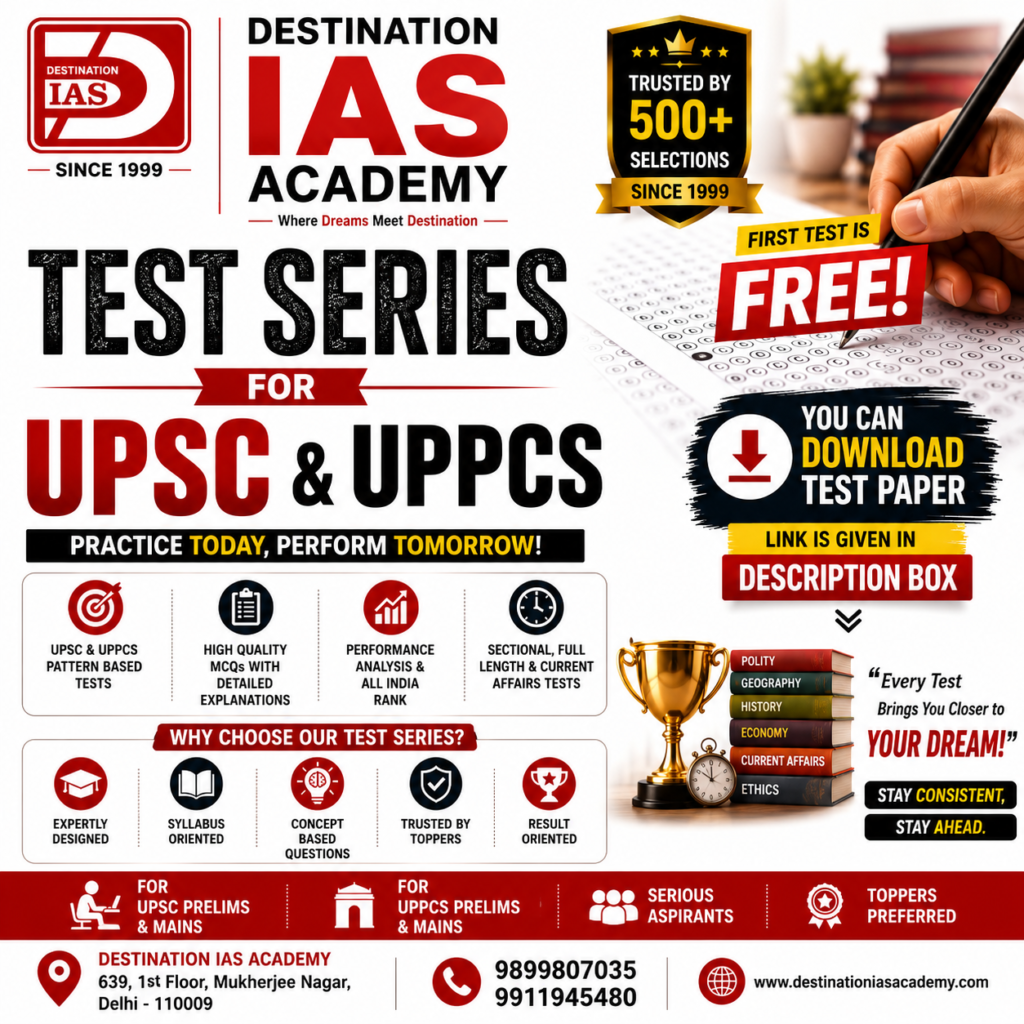
With a legacy of running since 1999 and 500+ successful selections, Destination IAS Academy has earned the trust of aspirants as a Best IAS Coaching Institute for General Studies (GS) and Political Science & International Relations (PSIR). Under the guidance of the Best Teacher of PSIR, the academy focuses on conceptual learning, analytical thinking, and examination-oriented preparation.
Why Every UPSC & UPPCS Aspirant Should Join a Test Series
A quality test series is much more than a collection of questions. It is a complete evaluation tool that helps aspirants:
- Assess their preparation objectively
- Improve conceptual clarity
- Identify weak areas for focused revision
- Develop effective time management
- Increase accuracy and reduce negative marking
- Build confidence for the actual examination
Regular testing transforms preparation into measurable progress.
Key Features of the Free Test Series
Examination-Oriented Questions
Each paper is designed to test conceptual understanding and analytical thinking rather than simple factual recall.
Comprehensive Coverage
The questions cover all major subjects, including: History, Geography, Indian Polity, Economy, Environment & Ecology, Science & Technology, Current Affairs, International Relations, Government Schemes, Uttar Pradesh Special Topics (for UPPCS)
Detailed Solutions
Every question is accompanied by a clear explanation, enabling students to understand not only the correct answer but also why the other options are incorrect
Performance Evaluation
Students can analyse their performance after every test and prepare targeted revision plans.
Benefits of Attempting the Test Series
Strengthens Conceptual Understanding : Regular practice helps connect static concepts with current developments, resulting in a deeper understanding of the syllabus.
Improves Time Management : Attempting papers within the prescribed time develops speed, accuracy, and decision-making skills.
Enhances Revision : Test analysis naturally highlights topics that require additional revision, making preparation more efficient.
Builds Examination Confidence : Consistent practice reduces anxiety and familiarises aspirants with the pressure of the actual examination.
Why Choose Destination IAS Academy?
Choosing the right mentorship plays a crucial role in Civil Services preparation.
Established Since 1999 – More than two decades of academic excellence and consistent guidance.
500+ Successful Selections -A strong record of helping aspirants achieve success in competitive examinations.
Expertise in GS & PSIR -Destination IAS Academy is widely recognised for excellence in General Studies and Political Science & International Relations (PSIR).
Guidance by the Best Teacher of PSIR -Students receive structured mentorship that focuses on: Conceptual clarity, Analytical thinking, Current affairs integration, High-quality answer writing, Personalised guidance
Download the Free Question Paper
You can attempt the latest Free UPSC & UPPCS Test Series Question Paper by clicking the link below.
📥 Download Free Test Series Question Paper (PDF)
Hindi Question
English Question
English Answer
Hindi AnswerTips to Maximise Your Score
- Attempt the paper in one sitting.
- Follow the actual examination time limit.
- Analyse every incorrect answer carefully.
- Revise weak topics immediately.
- Maintain an error notebook.
- Attempt every new test consistently.
Frequently Asked Questions (FAQs)
Is the test series completely free?
Yes. The objective is to help aspirants evaluate their preparation through quality questions.
Are detailed solutions provided?
Yes. Every question includes comprehensive explanations to strengthen conceptual understanding.
Is the test useful for both UPSC and UPPCS?
Yes. The test series is designed according to the evolving patterns of both examinations.
How often should I attempt mock tests? Ideally, one full-length test every week along with regular analysis and revision.
Conclusion
A quality Free Test Series for UPSC and UPPCS is one of the most effective ways to measure your preparation, improve conceptual clarity, and develop examination confidence. With structured evaluation, detailed explanations, and expert mentorship, aspirants can identify weaknesses and prepare more strategically.
Destination IAS Academy, recognised as a Best UPSC Coaching Institute and known for its excellence in GS and PSIR, has been guiding aspirants since 1999 with 500+ successful selections. Under the mentorship of the Best Teacher of PSIR, students receive a balanced approach that combines conceptual learning with examination-oriented practice.
Take the first step toward improving your preparation by downloading the free test paper and evaluating your performance today.
Contact Destination IAS Academy
Destination IAS Academy
Best IAS Coaching Institute for GS & PSIR
📍 639, 1st Floor, Mukherjee Nagar, Delhi – 110009
📞 9899807035 | 9911945480