Free Test Series for UPSC & UPPCS 2026–27 | Evaluate Your Preparation with Destination IAS Academy

Every successful UPSC or UPPCS aspirant has one habit in common—they regularly test their preparation. Reading books and making notes are important, but unless you assess yourself through quality mock tests, it is difficult to identify strengths, weaknesses, and the areas that require improvement.

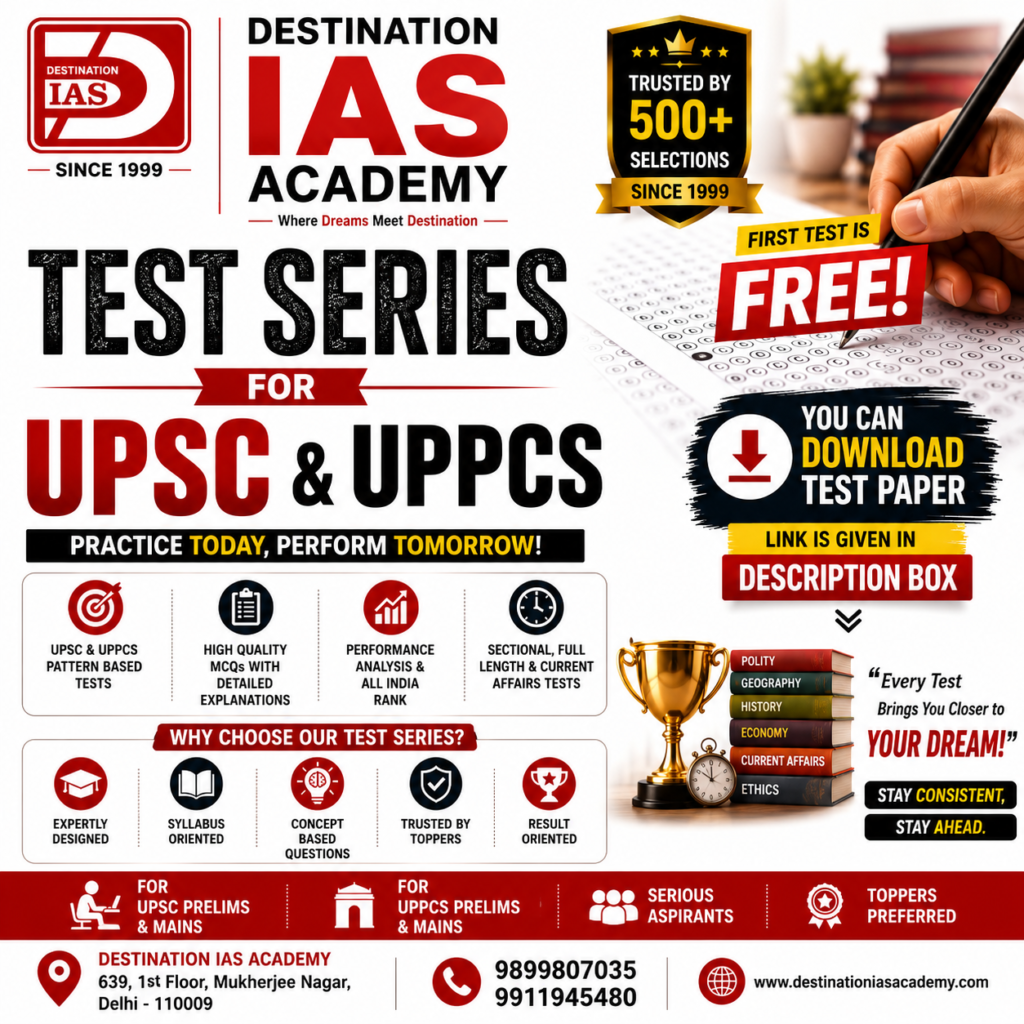
A well-designed Free Test Series for UPSC and UPPCS allows aspirants to experience the actual examination environment, improve conceptual understanding, and develop confidence through continuous practice.

With a legacy of running since 1999 and 500+ successful selections, Destination IAS Academy has earned the trust of aspirants as a Best IAS Coaching Institute for General Studies (GS) and Political Science & International Relations (PSIR). Under the guidance of the Best Teacher of PSIR, the academy focuses on conceptual learning, analytical thinking, and examination-oriented preparation.

Why Every UPSC & UPPCS Aspirant Should Join a Test Series

A quality test series is much more than a collection of questions. It is a complete evaluation tool that helps aspirants:

  • Assess their preparation objectively
  • Improve conceptual clarity
  • Identify weak areas for focused revision
  • Develop effective time management
  • Increase accuracy and reduce negative marking
  • Build confidence for the actual examination

Regular testing transforms preparation into measurable progress.

Key Features of the Free Test Series

Examination-Oriented Questions

Each paper is designed to test conceptual understanding and analytical thinking rather than simple factual recall.

Comprehensive Coverage

The questions cover all major subjects, including: History, Geography, Indian Polity, Economy, Environment & Ecology, Science & Technology, Current Affairs, International Relations, Government Schemes, Uttar Pradesh Special Topics (for UPPCS)

Detailed Solutions

Every question is accompanied by a clear explanation, enabling students to understand not only the correct answer but also why the other options are incorrect

Performance Evaluation

Students can analyse their performance after every test and prepare targeted revision plans.

Benefits of Attempting the Test Series

Strengthens Conceptual Understanding : Regular practice helps connect static concepts with current developments, resulting in a deeper understanding of the syllabus.

Improves Time Management : Attempting papers within the prescribed time develops speed, accuracy, and decision-making skills.

Enhances Revision : Test analysis naturally highlights topics that require additional revision, making preparation more efficient.

Builds Examination Confidence : Consistent practice reduces anxiety and familiarises aspirants with the pressure of the actual examination.

Why Choose Destination IAS Academy?

Choosing the right mentorship plays a crucial role in Civil Services preparation.

Established Since 1999 – More than two decades of academic excellence and consistent guidance.

500+ Successful Selections -A strong record of helping aspirants achieve success in competitive examinations.

Expertise in GS & PSIR -Destination IAS Academy is widely recognised for excellence in General Studies and Political Science & International Relations (PSIR).

Guidance by the Best Teacher of PSIR -Students receive structured mentorship that focuses on: Conceptual clarity, Analytical thinking, Current affairs integration, High-quality answer writing, Personalised guidance

Download the Free Question Paper

You can attempt the latest Free UPSC & UPPCS Test Series Question Paper by clicking the link below.

📥 Download Free Test Series Question Paper (PDF)

Hindi Question
English Question
English Answer
Hindi Answer

Tips to Maximise Your Score

  • Attempt the paper in one sitting.
  • Follow the actual examination time limit.
  • Analyse every incorrect answer carefully.
  • Revise weak topics immediately.
  • Maintain an error notebook.
  • Attempt every new test consistently.

Frequently Asked Questions (FAQs)

Is the test series completely free?

Yes. The objective is to help aspirants evaluate their preparation through quality questions.

Are detailed solutions provided?

Yes. Every question includes comprehensive explanations to strengthen conceptual understanding.

Is the test useful for both UPSC and UPPCS?

Yes. The test series is designed according to the evolving patterns of both examinations.

How often should I attempt mock tests? Ideally, one full-length test every week along with regular analysis and revision.

Conclusion

A quality Free Test Series for UPSC and UPPCS is one of the most effective ways to measure your preparation, improve conceptual clarity, and develop examination confidence. With structured evaluation, detailed explanations, and expert mentorship, aspirants can identify weaknesses and prepare more strategically.

Destination IAS Academy, recognised as a Best UPSC Coaching Institute and known for its excellence in GS and PSIR, has been guiding aspirants since 1999 with 500+ successful selections. Under the mentorship of the Best Teacher of PSIR, students receive a balanced approach that combines conceptual learning with examination-oriented practice.

Take the first step toward improving your preparation by downloading the free test paper and evaluating your performance today.

Contact Destination IAS Academy

Destination IAS Academy

Best IAS Coaching Institute for GS & PSIR

📍 639, 1st Floor, Mukherjee Nagar, Delhi – 110009

📞 9899807035 | 9911945480
🌐 https://www.destinationiasacademy.com

Political Science Optional Coaching in Delhi

Selecting the right optional subject is one of the most important decisions in the Civil Services Examination journey. Among all optional subjects, Political Science and International Relations (PSIR) has consistently remained one of the most preferred choices due to its dynamic nature, conceptual richness, and significant overlap with various components of the UPSC syllabus.

However, choosing the subject alone is not sufficient. Success depends upon conceptual understanding, analytical thinking, answer-writing skills, continuous revision, and expert mentorship. Therefore, selecting the right Political Science Optional Coaching in Delhi becomes an important step for aspirants seeking systematic preparation.

Delhi, particularly Mukherjee Nagar, has emerged as the country’s largest centre for Civil Services preparation because of its experienced faculty, academic environment, peer learning, and extensive study resources. Among the institutions that have earned the trust of aspirants over the years, Destination IAS Academy has been guiding students since 1999, producing 500+ successful selections, and has established itself as a trusted name in General Studies (GS) and Political Science & International Relations (PSIR).

Why Political Science Optional Continues to be One of the Most Preferred Subjects

Political Science is not merely a theoretical subject. It develops analytical abilities that help aspirants understand governance, constitutional institutions, public policy, international affairs, democracy, and contemporary political developments.

Some major advantages include:

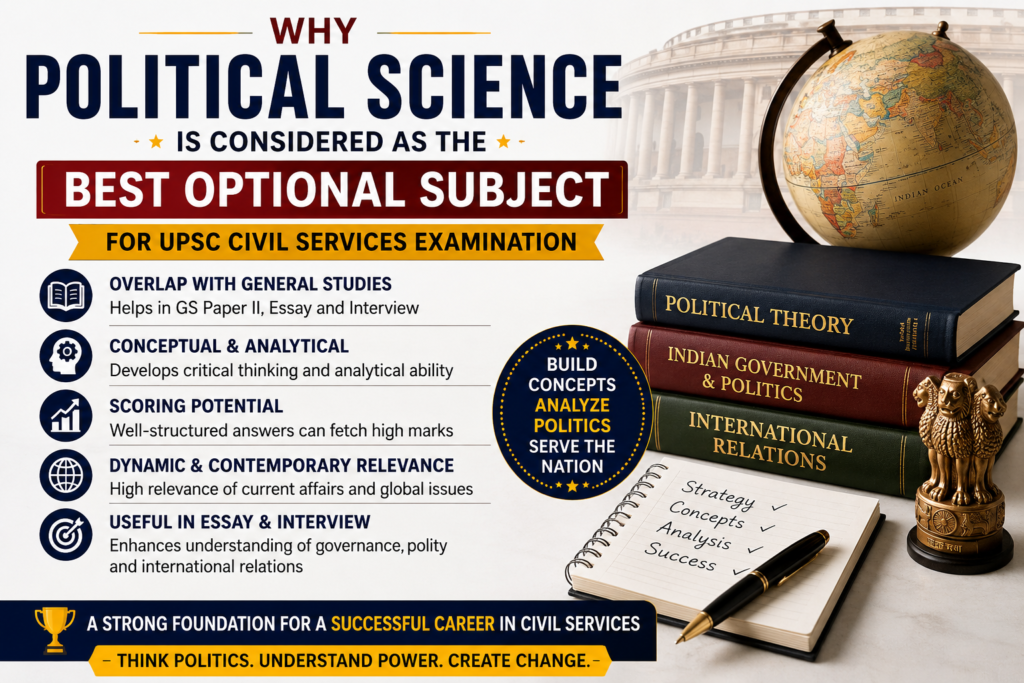
  • Extensive overlap with General Studies Paper-II
  • Strong contribution to Essay preparation
  • Excellent support for Ethics and Interview preparation
  • Continuous relevance through current affairs
  • Balanced combination of static and dynamic topics
  • Availability of abundant scholarly resources

Students who develop conceptual clarity often find Political Science to be intellectually rewarding throughout their Civil Services journey.

Why Expert Guidance Matters in Political Science Optional

Unlike many academic subjects, Political Science requires aspirants to connect classical political theories with present-day governance and international developments.

Quality guidance helps students learn:

  • Conceptual understanding instead of rote memorisation
  • Interlinking of topics across the syllabus
  • Application of political thinkers in analytical answers
  • Integration of current affairs with static concepts
  • Balanced and multidimensional answer writing
  • Effective revision techniques

A systematic approach saves valuable preparation time and prevents conceptual confusion.

Why Destination IAS Academy is a Trusted Name for Political Science Optional Coaching in Delhi

For aspirants looking for Political Science Optional Coaching in Delhi, Destination IAS Academy has earned credibility through its academic excellence and student-centric approach.

Established Legacy Since 1999

With more than two decades of experience, the institute has continuously evolved according to changing examination trends.

500+ Successful Selections

The institute has guided hundreds of aspirants who have successfully entered the Civil Services and other prestigious government services.

Expertise in General Studies and PSIR

Destination IAS Academy is widely recognised for its strong foundation in both:

  • General Studies (GS)
  • Political Science & International Relations (PSIR)

This integrated approach enables students to build conceptual connections across different papers.

Guidance by Kailash Mishra

Kailash Mishra is widely respected for his contribution to Political Science education.

His academic profile includes:

  • Editor-in-Chief – Trend Analysis
  • Author – India’s Foreign Policy in Changing Scenario

His teaching methodology focuses on:

  • Conceptual clarity
  • Analytical thinking
  • Contemporary political developments
  • International Relations
  • Structured answer writing
  • Personal mentorship

Building Conceptual Clarity: The Foundation of Political Science Preparation

One of the biggest mistakes made by aspirants is attempting to memorise content without understanding the underlying concepts.

Conceptual learning helps students:

  • Analyse issues from multiple perspectives.
  • Connect static concepts with current developments.
  • Write balanced and evidence-based answers.
  • Develop confidence during discussions and interviews.

A strong conceptual foundation ultimately leads to better retention and improved performance.

Importance of Continuous Revision

Political Science is a vast subject.

Regular revision should focus on:

  • Important constitutional concepts
  • Political thinkers
  • Landmark political developments
  • International relations
  • Contemporary governance issues

Revision transforms knowledge into long-term understanding.


Developing Analytical Thinking

Civil Services preparation is not about collecting information.

Students should learn to:

  • Examine different viewpoints.
  • Compare political systems.
  • Understand constitutional philosophy.
  • Evaluate public policies.
  • Analyse international developments objectively.

Analytical thinking distinguishes outstanding answers from average ones.


Conclusion

Choosing the right Political Science Optional Coaching in Delhi is an investment in a structured and disciplined preparation journey. The right mentorship, combined with conceptual clarity, continuous revision, analytical thinking, and effective answer-writing practice, enables aspirants to develop a deep understanding of Political Science and International Relations.

With a legacy of more than 25 years, 500+ successful selections, and recognised expertise in General Studies (GS) and Political Science & International Relations (PSIR), Destination IAS Academy continues to provide quality guidance for aspirants seeking comprehensive preparation. Established in 1999, the institute focuses on building strong conceptual foundations, integrating contemporary developments with core political ideas, and nurturing analytical thinking—qualities essential for long-term success in the Civil Services Examination.

Frequently Asked Questions (FAQs)

Why is Political Science Optional considered a popular optional subject?

Political Science combines conceptual learning with contemporary issues, making it relevant across multiple dimensions of Civil Services preparation while developing analytical thinking and writing skills.

How should I choose Political Science Optional Coaching in Delhi?

Evaluate the faculty’s experience, conceptual teaching approach, quality of study material, answer-writing support, mentorship, and track record of student success.

What should a good Political Science coaching programme include?

A comprehensive programme should provide complete syllabus coverage, structured notes, regular answer-writing practice, current affairs integration, revision sessions, and continuous mentorship.

Why is conceptual clarity important in Political Science?

Conceptual clarity helps students analyse issues critically, connect theories with contemporary developments, and write balanced, high-quality answers based on sound understanding rather than memorisation.

Contact Destination IAS Academy

Destination IAS Academy

Best IAS Coaching Institute for GS & Political Science (PSIR)

Established: Since 1999

Successful Selections: 500+

Address: 639, 1st Floor, Mukherjee Nagar, Delhi – 110009

Mobile: 9899807035 | 9911945480

Website: https://www.destinationiasacademy.com

Best Political Science Teacher for UPSC: How to Choose the Right Mentor for Success

UPSC Civil Services Examination is one of the most competitive examinations in India. Every year, thousands of aspirants choose Political Science and International Relations (PSIR) as their optional subject because of its scoring potential and significant overlap with General Studies and Essay papers. However, success in Political Science Optional depends largely on proper guidance, conceptual clarity, and answer-writing practice.

This makes selecting the Best Political Science Teacher for UPSC one of the most important decisions in an aspirant’s preparation journey. A good mentor not only explains the subject but also helps students develop analytical thinking and examination-oriented answer-writing skills.

Why Political Science Optional is a Popular Choice Among UPSC Aspirants

Political Science Optional has consistently remained one of the most preferred optional subjects among UPSC aspirants. The subject covers important topics such as Indian Constitution, Governance, International Relations, Political Theory, and Comparative Politics, which are highly relevant for the Civil Services Examination.

Some major advantages of Political Science Optional include:

  • Extensive overlap with General Studies Paper-II.
  • Useful content for Essay Writing.
  • Helps in UPSC Personality Test preparation.
  • Availability of quality study material and guidance.
  • Relevance of current affairs in answer writing.

Because of these advantages, many aspirants actively search for the Best Political Science Teacher for UPSC to gain a competitive edge.

What Makes the Best Political Science Teacher for UPSC?

Choosing a mentor should not be based solely on popularity. Aspirants should evaluate several important factors before joining a Political Science Optional course.

Strong Subject Expertise

The teacher must have a deep understanding of Political Theory, Indian Politics, Comparative Politics, and International Relations. Conceptual clarity is essential for understanding complex topics and writing analytical answers.

UPSC-Oriented Teaching Approach

The Civil Services Examination requires analytical and multidimensional answers. Therefore, the best Political Science teacher for UPSC focuses on examination-oriented preparation rather than purely academic teaching.

Current Affairs Integration

Political Science Optional is closely linked to contemporary developments. Topics such as India-US Relations, India-China Relations, Electoral Reforms, Global Governance, and Foreign Policy frequently appear in UPSC examinations.

A good mentor regularly integrates current affairs into classroom discussions and answer-writing practice.

Answer Writing Guidance

Success in UPSC Mains depends significantly on answer presentation. A quality teacher guides students on:

  • Structuring answers effectively.
  • Writing impactful introductions and conclusions.
  • Using political thinkers and scholars appropriately.
  • Incorporating contemporary examples.
  • Presenting balanced arguments.

Continuous Mentorship

Regular feedback, doubt-clearing sessions, and personalized guidance help aspirants improve consistently throughout their preparation.

Role of Political Science Optional in UPSC Preparation

Political Science Optional contributes significantly to overall UPSC preparation. Topics studied under the optional subject also help aspirants in:

General Studies Paper-II

Subjects such as:

  • Indian Constitution
  • Parliament
  • Judiciary
  • Governance
  • International Relations

are directly relevant for General Studies.

Essay Paper

Political Science develops critical thinking and analytical writing skills, which are extremely useful in essay writing.

UPSC Interview

Knowledge of political systems, governance structures, and international developments helps candidates perform confidently during the Personality Test.

Why Students Prefer Kailash Mishra for Political Science Optional ?

Among experienced Political Science mentors, Kailash Mishra has earned recognition for his structured teaching methodology and student-centric approach.

His academic contributions include:

  • Editor-in-Chief of Trend Analysis.
  • Author of the book India’s Foreign Policy in Changing Scenario.
  • Extensive experience in Political Science and General Studies guidance.

His teaching focuses on:

  • Conceptual clarity.
  • Current affairs integration.
  • Answer-writing skills.
  • Analytical understanding of political issues.
  • Personalized mentorship.

These qualities make him a preferred choice for many aspirants seeking guidance in Political Science Optional.

Why Choose Destination IAS Academy for Political Science Optional?

Established in 1999, Destination IAS Academy has been guiding Civil Services aspirants for more than two decades.

Experienced Faculty

Students receive guidance from experienced educators with a deep understanding of UPSC examination trends.

Comprehensive Study Material

The institute provides updated and well-structured study material designed according to the latest UPSC syllabus and examination pattern.

Regular Test Series

Topic-wise and full-length tests help students evaluate their preparation and improve answer-writing skills.

Current Affairs-Based Learning

Special emphasis is given to connecting static concepts with contemporary national and international developments.

Individual Mentorship

Students receive continuous guidance and support throughout their preparation journey.

How to Select the Best Political Science Teacher for UPSC ?

Before enrolling in any coaching program, aspirants should consider the following factors:

  • Teaching experience of the faculty.
  • Quality of study material.
  • Availability of answer-writing support.
  • Previous student feedback.
  • Current affairs coverage.
  • Test series and evaluation mechanism.
  • Mentorship and doubt-clearing support.

A careful assessment of these factors can help students choose the right mentor and maximize their chances of success.

Conclusion

Choosing the Best Political Science Teacher for UPSC can significantly impact an aspirant’s performance in the Civil Services Examination. A mentor who combines subject expertise, current affairs awareness, answer-writing guidance, and personalized mentorship can help students develop the skills required to excel in UPSC Mains and Interview.

For aspirants looking for structured guidance in Political Science Optional, expert mentorship and a disciplined preparation strategy remain the key ingredients for success.

Contact Destination IAS Academy

Destination IAS Academy

Address: 639, 1st Floor, Mukherjee Nagar, Delhi – 110009

Mobile: 9899807035, 9911945480, website: https://www.destinationiasacademy.com

Biological Deterrents at the Border

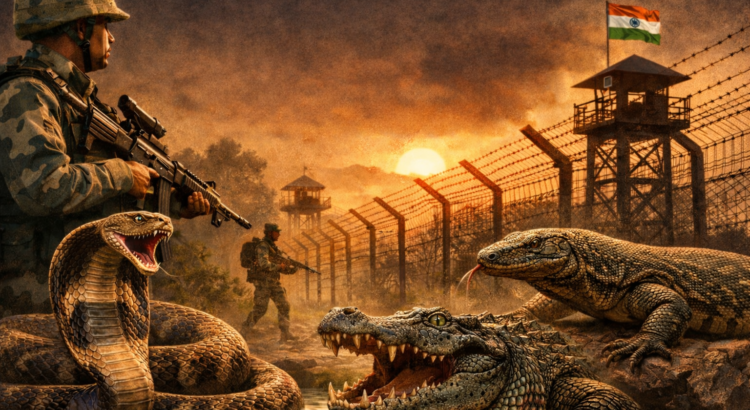
Biological Deterrents at the Border: A New Era in India’s Security Strategy

India’s border management has always required a blend of strategy, adaptability, and innovation. With diverse terrains ranging from deserts to dense forests and riverine belts, traditional methods such as fencing and surveillance often face limitations. Recently, a unique and controversial idea has emerged in discussions—the use of biological deterrents like reptiles to secure difficult border areas.

At Destination IAS Academy, we believe that understanding such evolving policy discussions is crucial for aspirants preparing for competitive examinations like UPSC. This topic not only touches upon internal security but also intersects with environmental concerns, governance, and ethical debates.

This blog explores the concept in depth, examining its origin, feasibility, challenges, and broader implications in a structured and detailed manner.

Understanding the Concept of Biological Deterrents

The term biological deterrents refers to the use of living organisms to discourage or prevent certain activities. In the context of border security, this involves introducing potentially dangerous animals—such as snakes or crocodiles—into sensitive areas to act as natural barriers.

The Border Security Force (BSF) is reportedly examining whether such an approach could be effective in regions where physical fencing is not feasible. Nearly 175 km of India’s 4,096 km border with Bangladesh consists of riverine and marshy terrain, particularly in the Sundarbans region of West Bengal. These areas are difficult to monitor continuously due to water flow, dense vegetation, and shifting landforms.

For institutions like Destination IAS Academy, such topics are important case studies in internal security, demonstrating how unconventional strategies are sometimes explored when conventional systems fall short.

Why Traditional Border Measures Fall Short

Border fencing has been one of India’s primary strategies to curb illegal infiltration, smuggling, and cross-border crimes. However, certain geographical conditions make it nearly impossible to implement.

Riverine borders constantly shift due to erosion and sedimentation. Marshlands remain waterlogged for most of the year, making construction impractical. Additionally, electronic surveillance systems such as sensors and cameras often fail due to harsh environmental conditions like humidity, floods, and dense foliage.

In such “dark zones,” where visibility and accessibility are low, illegal activities such as cattle smuggling and narcotics trafficking continue to pose serious challenges. This has led policymakers to explore alternative methods, including the idea of biological deterrents.

At Destination IAS Academy, we emphasize that such challenges highlight the importance of geography in shaping security policies—an essential insight for UPSC aspirants.

Origin of the Idea: Policy Direction and Innovation

The idea of deploying reptiles as a deterrent did not emerge randomly. It is believed to have originated from a directive issued by the Union Home Ministry, which encouraged exploring innovative ways to strengthen border security.

The objective was to create a “natural layer of defense” in areas where physical infrastructure is ineffective. By leveraging natural predators, authorities aim to instill fear and discourage illegal crossings without relying solely on manpower or technology.

In March 2026, internal communications were reportedly circulated among senior BSF officials to evaluate the feasibility of this proposal. This indicates that the idea is still at a conceptual and exploratory stage rather than being an approved or implemented policy.

For students at Destination IAS Academy, this development serves as an example of how governance often involves experimentation and consultation before decision-making.

Current Status: Still in the Feasibility Stage

As of April 7, 2026, the proposal remains under discussion and has not been implemented. The BSF is currently assessing various aspects, including operational practicality, safety concerns, and environmental implications.

Field officers have been asked to provide feedback based on ground realities. Many have expressed skepticism about the effectiveness of such a strategy. Unlike trained security forces or even guard animals, reptiles cannot be controlled or directed.

This stage of evaluation is critical in policymaking. It reflects the government’s attempt to balance innovation with practicality—a principle often highlighted in the teachings at Destination IAS Academy.

Concerns Raised by Field Commanders

One of the strongest criticisms of the proposal comes from officers working on the ground. Their concerns are rooted in practical experience and operational challenges.

Reptiles such as snakes and crocodiles are inherently unpredictable. They cannot differentiate between a smuggler and a local resident, such as a fisherman or farmer. This raises serious questions about their reliability as a security tool.

Moreover, border areas are not isolated zones. They are often densely populated, with communities living in close proximity to these vulnerable regions. Introducing dangerous animals could put innocent lives at risk.

At Destination IAS Academy, we encourage students to analyze such issues critically, considering both administrative intent and ground-level realities.

Public Safety: A Major Risk Factor

One of the most significant concerns associated with this proposal is public safety. Border regions, especially in West Bengal, are home to large populations engaged in agriculture and fishing.

During the monsoon season, floods are common in these areas. If reptiles are introduced into border zones, there is a high probability that they could be carried into nearby villages by floodwaters. This could lead to fatal encounters and widespread panic among residents.

The government’s primary responsibility is to ensure the safety and well-being of its citizens. Any policy that potentially endangers civilian lives must be carefully scrutinized.

At Destination IAS Academy, such issues are discussed in the context of ethics and governance, helping aspirants develop a balanced perspective.

Ecological Impact and Legal Concerns

Another critical dimension of this debate is its environmental impact. The Sundarbans region is a delicate ecosystem and a UNESCO World Heritage Site. It is home to diverse flora and fauna, including endangered species.

Introducing large numbers of predators could disrupt the ecological balance. It may lead to unintended consequences, such as a decline in certain species or increased human-wildlife conflict.

Additionally, the proposal may conflict with the Wildlife Protection Act, 1972, which regulates the handling and conservation of wildlife in India. Any attempt to relocate or release animals must comply with strict legal guidelines.

For students at Destination IAS Academy, this highlights the importance of integrating environmental awareness into policy analysis.

Operational Challenges: Control and Maintenance

From an operational standpoint, the use of reptiles poses several logistical challenges. Unlike trained dogs or surveillance equipment, reptiles cannot be monitored, controlled, or recalled once released.

There are also questions about how these animals would be sourced and maintained. Would they be bred in captivity or captured from the wild? How would their health and population be managed?

Furthermore, there is no guarantee that the presence of reptiles would effectively deter illegal activities. Smugglers and infiltrators may find ways to adapt or circumvent such measures.

These practical difficulties underline the complexity of implementing unconventional strategies—a topic often explored in depth at Destination IAS Academy.

Conclusion: Innovation vs Practicality

The idea of using biological deterrents for border security is undoubtedly innovative, but it comes with significant risks and challenges. While it reflects the government’s willingness to explore unconventional strategies, its feasibility remains questionable.

Public safety, ecological balance, legal constraints, and operational difficulties are major concerns that cannot be overlooked. As of now, the proposal remains in the discussion stage, with no official implementation.

For aspirants preparing at Destination IAS Academy, this topic serves as an excellent case study in internal security, environmental governance, and ethical decision-making. It highlights the complexities of policymaking in a diverse and dynamic country like India. f you want to join the best IAS coaching in Delhi, we invite you to visit our Mukherjee Nagar center or contact us today to take a focused step toward achieving your UPSC goals.

Ultimately, effective border management requires a careful balance between innovation and practicality. Policies must be not only creative but also safe, sustainable, and aligned with the broader interests of society.

Kaynes Semiconductor Plant Inauguration

India is steadily moving towards becoming a key player in the global semiconductor industry, and the inauguration of the Kaynes Semiconductor Plant at Sanand, Gujarat, marks a significant milestone in this journey. This ₹3,300 crore facility is one of the largest semiconductor manufacturing units in India and forms a crucial part of the government’s India Semiconductor Mission (ISM). With the growing global demand for semiconductors across various sectors such as automotive, electronics, and industrial applications, India is strategically positioning itself to reduce import dependence, foster technological self-reliance, and strengthen its position in the global high-tech manufacturing ecosystem.

Background of India’s Semiconductor Industry

Semiconductors are the backbone of modern electronics, powering devices from smartphones and computers to automobiles and industrial machinery. Historically, India has relied heavily on semiconductor imports, primarily from countries like Taiwan, South Korea, and the United States. Recognizing the strategic importance of chip manufacturing for both economic growth and national security, the Indian government launched the India Semiconductor Mission (ISM) in 2021. The mission aims to create a robust semiconductor ecosystem encompassing design, fabrication, assembly, testing, and packaging.

Before this initiative, India’s semiconductor sector was limited mostly to design and chip fabrication for small-scale applications. The absence of large-scale manufacturing led to high import dependence, which posed risks during global chip shortages, such as the one experienced during the COVID-19 pandemic. To counter these vulnerabilities, ISM introduced policies offering financial incentives, technology partnerships, and infrastructure support for domestic manufacturers. These measures aim to enable India to not only meet domestic demand but also become a significant exporter of semiconductors.

Details of the Kaynes Semiconductor Plant

The Kaynes Semiconductor Plant, located in Sanand GIDC, Ahmedabad, Gujarat, focuses on OSAT/ATMP (Outsourced Semiconductor Assembly, Test, Marking & Packaging) operations. OSAT refers to specialized services that handle the assembly, testing, marking, and packaging of semiconductor chips. The plant has a production capacity of approximately 6 million units per day, catering to domestic and export markets. This facility primarily manufactures chips used in automobiles, industrial applications, and consumer electronics, reflecting India’s strategic focus on sectors critical to technological growth and economic development.

The plant was inaugurated by Prime Minister Narendra Modi in April 2026. During the inauguration, PM Modi emphasized the importance of building a self-reliant semiconductor ecosystem in India and highlighted the role of such high-tech manufacturing facilities in positioning India as a global technology hub. The establishment of this plant not only strengthens India’s manufacturing capabilities but also acts as a catalyst for attracting further investments in the semiconductor sector, promoting Make in India and Atmanirbhar Bharat objectives.

Strategic Significance of the Plant

  • Reducing Import Dependence: By manufacturing semiconductors domestically, India can significantly reduce its reliance on imports, ensuring supply chain resilience for critical industries such as automotive, aerospace, and defense.
  • Global Competitiveness: The plant enables India to participate in high-value segments of the semiconductor value chain, positioning the country as a reliable global supplier of chips.
  • Technological Advancement: The facility serves as a hub for research and development, allowing India to develop expertise in advanced chip assembly, testing, and packaging technologies.
  • Economic Growth: With a large workforce and ancillary industries developing around the plant, it contributes to employment generation, regional industrial growth, and enhancement of GDP.
  • National Security: Domestic semiconductor production is critical for defense electronics, cybersecurity devices, and AI-driven applications, reducing strategic vulnerabilities.

Role of the India Semiconductor Mission (ISM)

The Kaynes plant is an integral part of India Semiconductor Mission 2.0, which aims to establish multiple semiconductor manufacturing and packaging facilities across the country. According to Electronics & IT Minister Ashwini Vaishnaw, four semiconductor plants are expected to be operational by the end of 2026, with two more planned for 2027. The mission focuses on creating a comprehensive ecosystem that includes design, fabrication, assembly, testing, and exports.

The ISM provides financial incentives, including capital expenditure support, technology tie-ups, and subsidies for domestic production. These measures encourage companies to invest in advanced semiconductor technologies, ensuring India develops end-to-end capabilities and reduces technological dependency. The Kaynes plant serves as a model, demonstrating the tangible outcomes of policy support and signaling confidence to international investors.

Economic Impact

  • Import Substitution: By producing chips domestically, India reduces billions of dollars of semiconductor imports annually, strengthening the trade balance.
  • Employment Generation: The plant offers direct and indirect employment opportunities, boosting local economies and fostering skill development.
  • Industrial Cluster Formation: Ancillary industries, logistics providers, and service sectors benefit, leading to the development of a technology cluster in Sanand.
  • Revenue Generation: Taxes, duties, and corporate profits contribute to government revenue, supporting further industrial and technological development.
  • Innovation Ecosystem: The plant encourages startups and R&D in semiconductor design, testing, and manufacturing, creating a sustainable innovation environment.

Technological Significance

From a technological perspective, the Kaynes Semiconductor Plant represents a major leap in India’s capabilities. OSAT/ATMP operations require precision engineering, advanced machinery, and rigorous quality control. Mastery of these processes allows India to:

  • Develop cutting-edge technologies for automotive electronics, AI hardware, and consumer electronics.
  • Reduce reliance on foreign technology providers.
  • Foster innovation in chip design, materials science, and testing protocols.
  • Support sectors such as electric vehicles, renewable energy technologies, and industrial automation that depend on reliable semiconductor supply.

Policy Implications

From a technological perspective, the Kaynes Semiconductor Plant represents a major leap in India’s capabilities. OSAT/ATMP operations require precision engineering, advanced machinery, and rigorous quality control. Mastery of these processes allows India to:

  • Develop cutting-edge technologies for automotive electronics, AI hardware, and consumer electronics.
  • Reduce reliance on foreign technology providers.
  • Foster innovation in chip design, materials science, and testing protocols.
  • Support sectors such as electric vehicles, renewable energy technologies, and industrial automation that depend on reliable semiconductor supply.

Challenges and Opportunities

Challenges:

  • Global Competition: Taiwan, South Korea, and the US dominate semiconductor manufacturing.
  • Technological Complexity: Semiconductor fabrication and packaging require high-precision technology and continuous innovation.
  • Raw Material Dependence: India still relies on imports for some critical materials and equipment.

Opportunities:

  • Skill Development: Build a highly skilled workforce in semiconductor technologies.
  • Startup Innovation: Encourage domestic startups to develop chip designs, AI solutions, and electronic components.
  • Export Potential: Position India as a reliable global supplier of semiconductors.
  • R&D Advancement: Promote research in advanced chip technologies, including AI, quantum computing, and automotive electronics.

Global Perspective

The global semiconductor market is projected to reach $1 trillion by 2030, driven by demand in smartphones, electric vehicles, AI applications, and industrial automation. Geopolitical tensions and supply chain disruptions have highlighted the critical need for domestic semiconductor production. India’s initiatives, including the Kaynes Semiconductor Plant, align with global trends, ensuring that the country is strategically positioned in high-value technology supply chains.

Countries worldwide are investing in semiconductor manufacturing to safeguard their economies and security. India’s efforts ensure it does not remain a passive consumer but becomes an active contributor and innovator in the global semiconductor ecosystem.

Conclusion

The inauguration of the Kaynes Semiconductor Plant at Sanand, Gujarat, represents a historic leap for India’s semiconductor ambitions. It underscores the government’s commitment to building a self-reliant and globally competitive semiconductor ecosystem. By combining strategic investments, policy support, and technological expertise, India is poised to become a significant player in the global semiconductor industry.

The plant strengthens economic growth, employment, and technological capabilities while reducing import dependence. With the expansion of the India Semiconductor Mission and the establishment of additional semiconductor facilities, India is set to transform its electronics manufacturing landscape, emerge as a hub for innovation, and secure its position in the global high-tech supply chain.